Open-Ended Foundation Models Through the Lens of Deep Manifold
从深度流形看开放式基础模型

1. Open-Ended AI Needs a Mathematical Framework 开放式 AI 需要一个数学框架
Open-Ended AI needs not only larger models or more diverse environments, but also a deeper mathematical framework for understanding how intelligence emerges under changing conditions. The Open-Ended Foundation Model has strong mathematical-reasoning potential because it is not limited to solving a fixed task. Its deeper challenge is to remain learnable while the task, environment, data distribution, reward structure, and interaction rules continue to change. The Tree of Life offers a powerful analogy: life did not emerge as one linear path toward a single objective, but as a branching, adaptive, open-ended process shaped by changing environments, mutations, selection pressures, and historical constraints.
开放式 AI 不仅需要更大的模型或更多样化的环境,也需要一个更深层的数学框架,用来理解智能如何在不断变化的条件下涌现。开放式基础模型具有很强的数学推理潜力,因为它并不局限于解决某一个固定任务。它更深层的挑战,是在任务、环境、数据分布、奖励结构和交互规则不断变化时,仍然保持可学习性。生命之树提供了一个有力的类比:生命并不是沿着一条线性路径朝向某个单一目标演化出来的,而是在不断变化的环境、突变、选择压力和历史约束下,形成了一个分支式、适应性的开放过程。
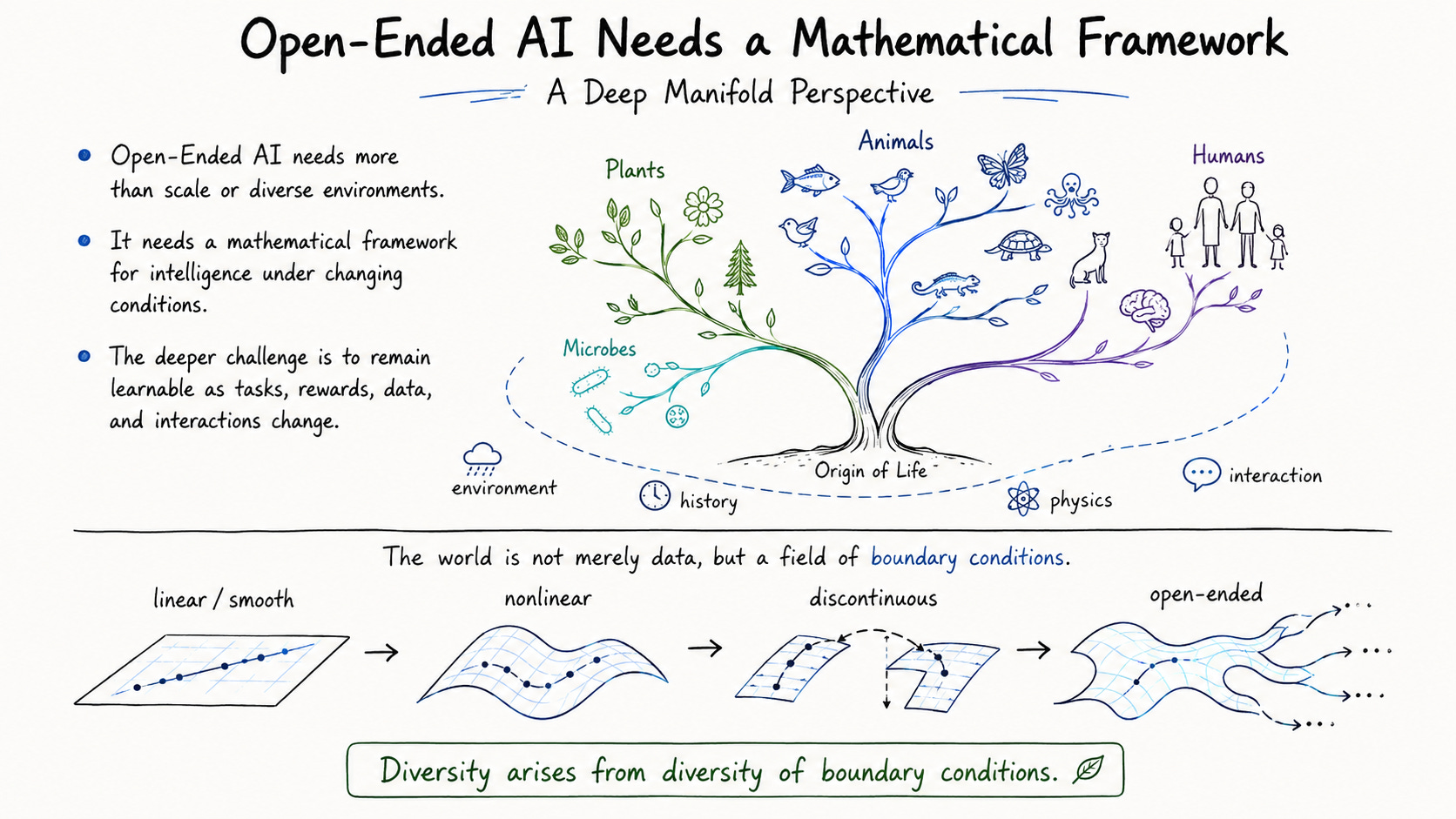
Through the lens of Deep Manifold, the world is not merely data but a field of boundary conditions. Each being — human, animal, plant, microbe, or planet — can be viewed as a manifold, whose form is shaped by its environment, history, physical constraints, and computational interactions. The Tree of Life shows that the diversity of beings arises from the diversity of boundary conditions: some evolutionary paths are relatively smooth and stable, while others are high-order nonlinear, discontinuous, and open-ended. This is why Open-Ended AI requires a mathematical language that can describe not only optimization, but branching, deformation, adaptation, and the emergence of new manifold structures.
通过深度流形的视角,世界并不仅仅是数据,而是一个由边界条件构成的场。每一个存在者——人、动物、植物、微生物或星球——都可以被视为一个流形,其形态由环境、历史、物理约束和计算交互共同塑造。生命之树表明,存在者的多样性来自边界条件的多样性:有些演化路径相对平滑且稳定,而另一些则具有高阶非线性、不连续性和开放性。这就是为什么开放式 AI 需要一种数学语言,不仅能够描述优化,还能够描述分支、变形、适应,以及新的流形结构如何涌现。
2. The World as a Field of Boundary Conditions 世界作为边界条件之场
Deep Manifold provides a way to formalize this view. In conventional AI, a model is usually trained under a fixed task, fixed dataset, fixed reward, or fixed evaluation metric. Together, these define a relatively closed boundary condition: the learning space is constrained in advance, and success is measured by convergence toward a predefined objective. The model may become larger or more capable, but the space in which it learns remains largely fixed.
深度流形提供了一种形式化这一观点的方法。在传统 AI 中,模型通常是在固定任务、固定数据集、固定奖励或固定评估指标下进行训练的。这些因素共同定义了一个相对封闭的边界条件:学习空间预先受到约束,而成功则由模型是否收敛到某个预设目标来衡量。模型可以变得更大、更有能力,但它所处的学习空间基本上仍然是固定的。
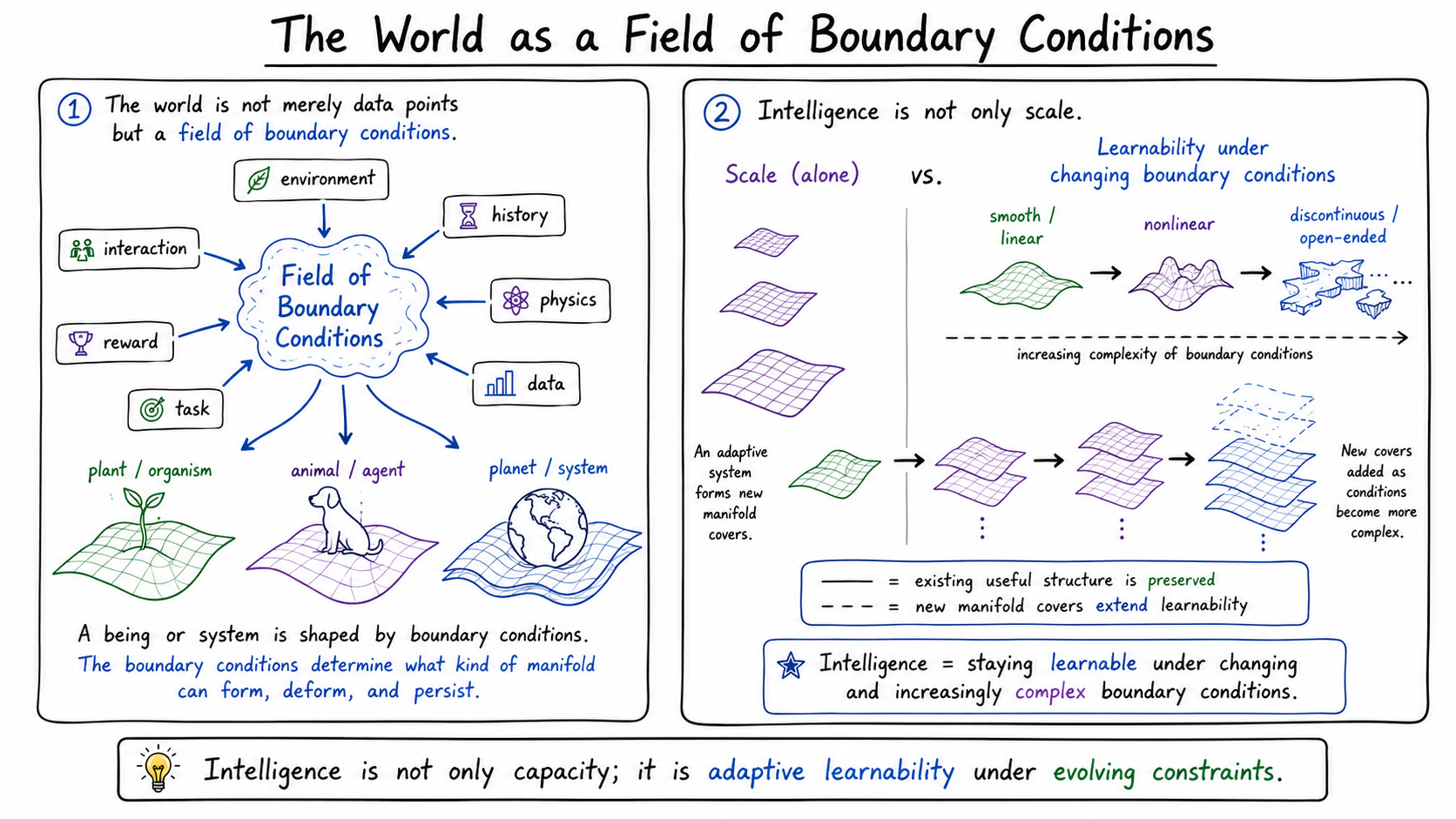
Open-Ended AI changes this problem. The system must continually encounter, generate, and adapt to new boundary conditions. From the Deep Manifold perspective, open-endedness is not merely task generation; it is the continuous deformation of the learning space. New tasks, environments, rewards, and interactions reshape the admissible manifold, generate new 不动点 classes, and force the system to form new manifold covers rather than converge to a single closed solution.
开放式 AI 改变了这个问题。系统必须不断遭遇、生成并适应新的边界条件。从深度流形的角度看,开放性并不仅仅是任务生成;它是学习空间的连续变形。新的任务、环境、奖励和交互会重塑可容许流形,生成新的不动点类,并迫使系统形成新的流形覆盖,而不是收敛到某一个封闭的单一解。
3. Open-Endedness as Deformation of Learning Space 开放性作为学习空间的变形
Deep Manifold provides a way to formalize this view. In conventional AI, a model is usually trained under a fixed task, fixed dataset, fixed reward, or fixed evaluation metric. These define a closed boundary condition. Open-Ended AI changes the problem: the system must continually encounter, generate, and adapt to new boundary conditions. From the Deep Manifold perspective, open-endedness is not merely task generation; it is the continuous deformation of the learning space. New tasks, environments, rewards, and interactions reshape the admissible manifold, generate new fixed-point classes, and force the system to form new manifold covers rather than converge to a single closed solution.
深度流形提供了一种形式化这一观点的方法。在传统 AI 中,模型通常是在固定任务、固定数据集、固定奖励或固定评估指标下进行训练的。这些因素定义了一个封闭的边界条件。开放式 AI 改变了这个问题:系统必须不断遭遇、生成并适应新的边界条件。从深度流形的角度看,开放性并不仅仅是任务生成;它是学习空间的连续变形。新的任务、环境、奖励和交互会重塑可容许流形,生成新的不动点类,并迫使系统形成新的流形覆盖,而不是收敛到某一个封闭的单一解。
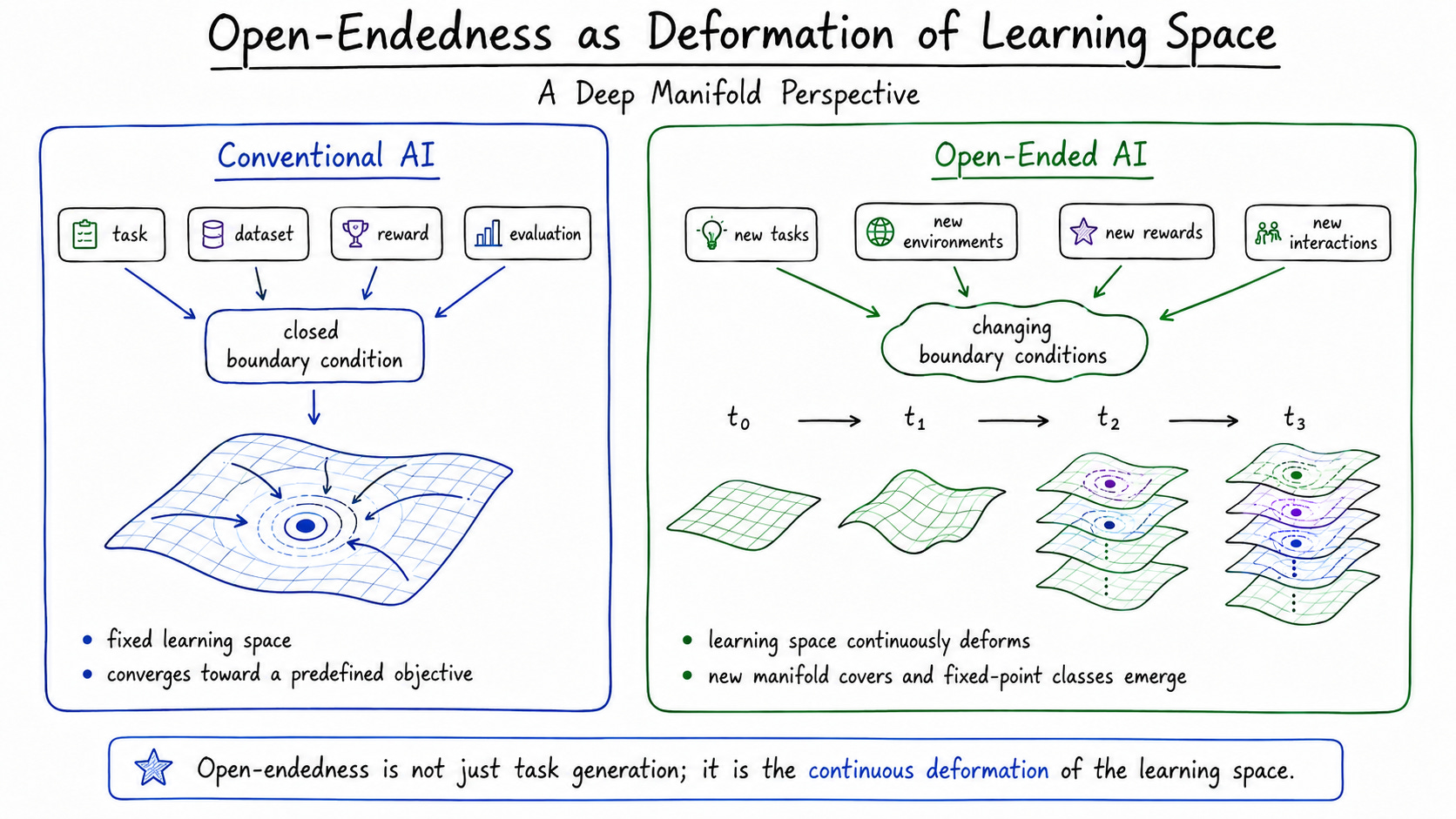
Deep Manifold provides a way to formalize this view. In conventional AI, a model is usually trained under a fixed task, fixed dataset, fixed reward, or fixed evaluation metric. These define a closed boundary condition. Open-Ended AI changes the problem: the system must continually encounter, generate, and adapt to new boundary conditions. From the Deep Manifold perspective, open-endedness is not merely task generation; it is the continuous deformation of the learning space. New tasks, environments, rewards, and interactions reshape the admissible manifold, generate new fixed-point classes, and force the system to form new manifold covers rather than converge to a single closed solution.
深度流形提供了一种形式化这一观点的方法。在传统 AI 中,模型通常是在固定任务、固定数据集、固定奖励或固定评估指标下进行训练的。这些因素定义了一个封闭的边界条件。开放式 AI 改变了这个问题:系统必须不断遭遇、生成并适应新的边界条件。从深度流形的角度看,开放性并不仅仅是任务生成;它是学习空间的连续变形。新的任务、环境、奖励和交互会重塑可容许流形,生成新的不动点类,并迫使系统形成新的流形覆盖,而不是收敛到某一个封闭的单一解。
4. Manifold Federation: From Local Models to a Richer World Model 流形联邦:从局部模型到更丰富的世界模型
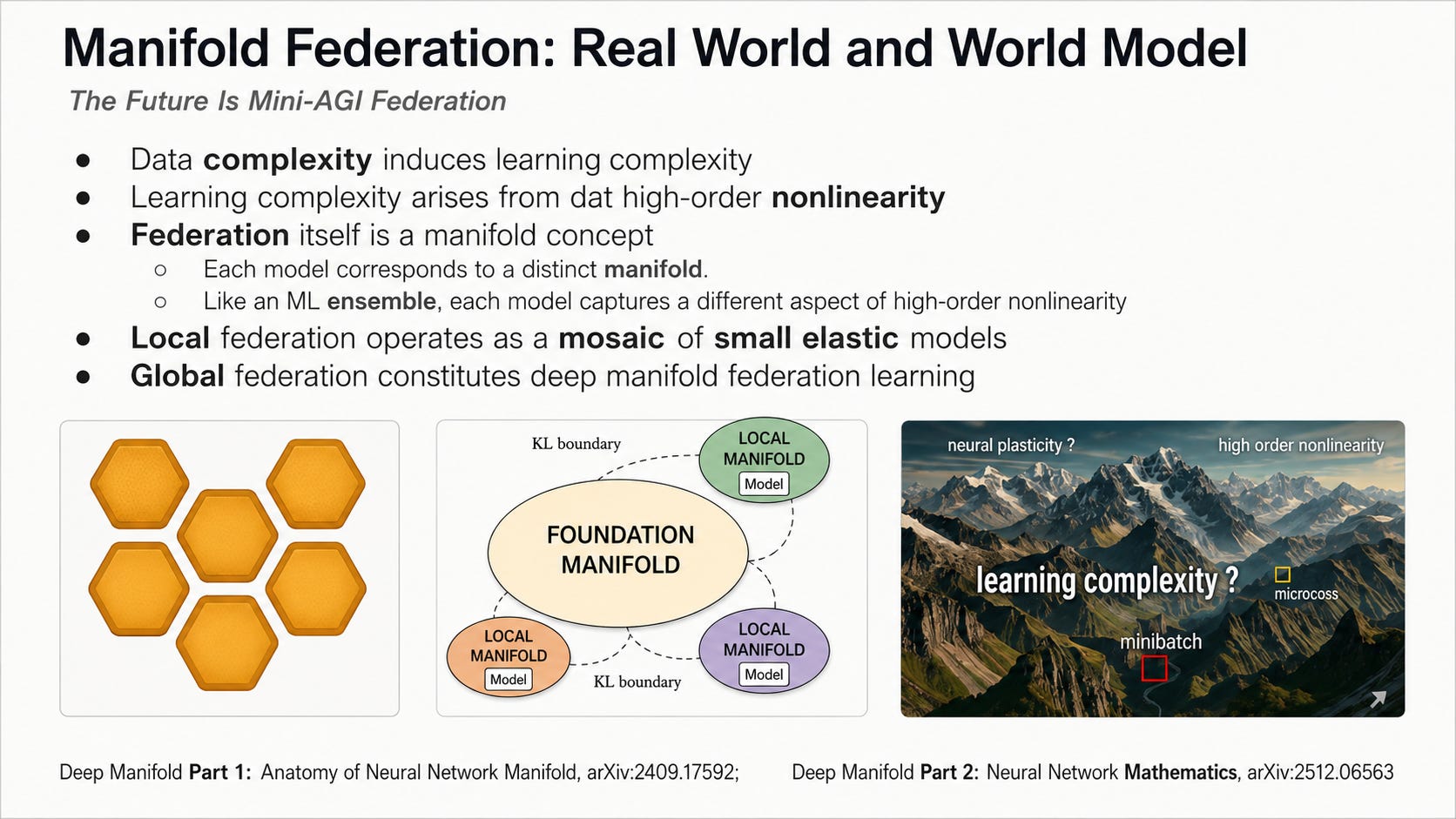
This also connects to the idea of the Manifold Federation. Real-world intelligence is not a single monolithic manifold. It is more like a federation of local manifolds, where each model, agent, environment, or domain captures a different aspect of high-order nonlinearity. Local federation operates as a mosaic of small elastic models, while global federation forms a deeper manifold-learning system. In this sense, a future open-ended foundation model may resemble a mini-AGI federation: many local models or local manifolds interacting through shared boundaries, KL constraints, data complexity, and learning complexity. Each local manifold contributes a partial view, while the global system coordinates them into a richer world model.
这也连接到流形联邦的思想。现实世界的智能并不是一个单一的、整体化的流形。它更像是由多个局部流形组成的联邦:每一个模型、智能体、环境或领域,都捕捉了高阶非线性的不同侧面。局部联邦像是由许多小型弹性模型组成的马赛克,而全局联邦则形成一个更深层的流形学习系统。
从这个意义上说,未来的开放式基础模型可能类似于一个迷你 AGI 联邦:许多局部模型或局部流形通过共享边界、KL 约束、数据复杂度和学习复杂度相互作用。每一个局部流形都贡献一个局部视角,而全局系统则将它们协调成一个更丰富的世界模型。
Deep Manifold can provide a mathematical language for this process: boundary conditions, manifold covers, fixed-point classes, learning complexity, and manifold federation. This framework can help explain why data complexity induces learning complexity, why high-order nonlinearity makes open-ended learning difficult, and why intelligence may require a federation of adaptive local models rather than one static global model. In this view, Open-Ended AI is the study of learning systems whose boundary conditions keep expanding, forcing the model to form new manifold covers, discover new fixed-point classes, and sustain intelligence as an evolving numerical process rather than a closed optimization result.
深度流形可以为这一过程提供一种数学语言:边界条件、流形覆盖、不动点类、学习复杂度和流形联邦。这个框架有助于解释:为什么数据复杂度会诱发学习复杂度,为什么高阶非线性会使开放式学习变得困难,以及为什么智能可能需要一个由自适应局部模型组成的联邦,而不是一个静态的全局模型。在这一视角下,开放式 AI 研究的是这样一种学习系统:它的边界条件不断扩展,迫使模型形成新的流形覆盖,发现新的不动点类,并将智能维持为一个持续演化的数值过程,而不是一个封闭优化的结果。
5. Open-Ended Model Beyond the World Model 超越世界模型的开放式模型
The term world model is useful, but it remains difficult to define precisely. Across cognitive science, reinforcement learning, and modern AI, it generally refers to an internal predictive structure that allows a system to simulate possible futures before acting. Yet different fields set different thresholds: some treat latent prediction as sufficient, while others require action-conditioned rollout, planning, or causal consequence. This is why there is no single unified definition: “world model” mixes several levels at once — prediction, simulation, planning, grounding, action, and representation. see What Is a World Model and What It Is Not?
“世界模型”这个术语是有用的,但它仍然很难被精确定义。在认知科学、强化学习和现代 AI 中,它通常指一种内部预测结构,使系统能够在行动之前模拟可能的未来。然而,不同领域对它设定的门槛并不相同:有些观点认为潜在预测已经足够,而另一些观点则要求它必须支持以动作为条件的展开、规划或因果后果推演。这就是为什么世界模型没有一个统一定义:“世界模型”同时混合了预测、模拟、规划、接地、行动和表征等多个层次。什么是世界模型, 它又不是什么?
From the Deep Manifold perspective, an open-ended model may be a better and more general framing. A world model emphasizes internal prediction of world dynamics, but an open-ended model emphasizes the continuous expansion of boundary conditions. It does not merely simulate a world; it continually encounters, generates, and adapts to new tasks, environments, rewards, data distributions, and interaction rules. Its essential property is not only prediction, but the ability to form new manifold covers and new fixed-point classes under changing conditions.
从深度流形的角度看,开放式模型可能是一个更好、也更一般的框架。世界模型强调对世界动态的内部预测,而开放式模型强调边界条件的持续扩展。它并不只是模拟一个世界;它会不断遭遇、生成并适应新的任务、环境、奖励、数据分布和交互规则。它的核心性质不只是预测,而是在不断变化的条件下形成新的流形覆盖和新的不动点类的能力。
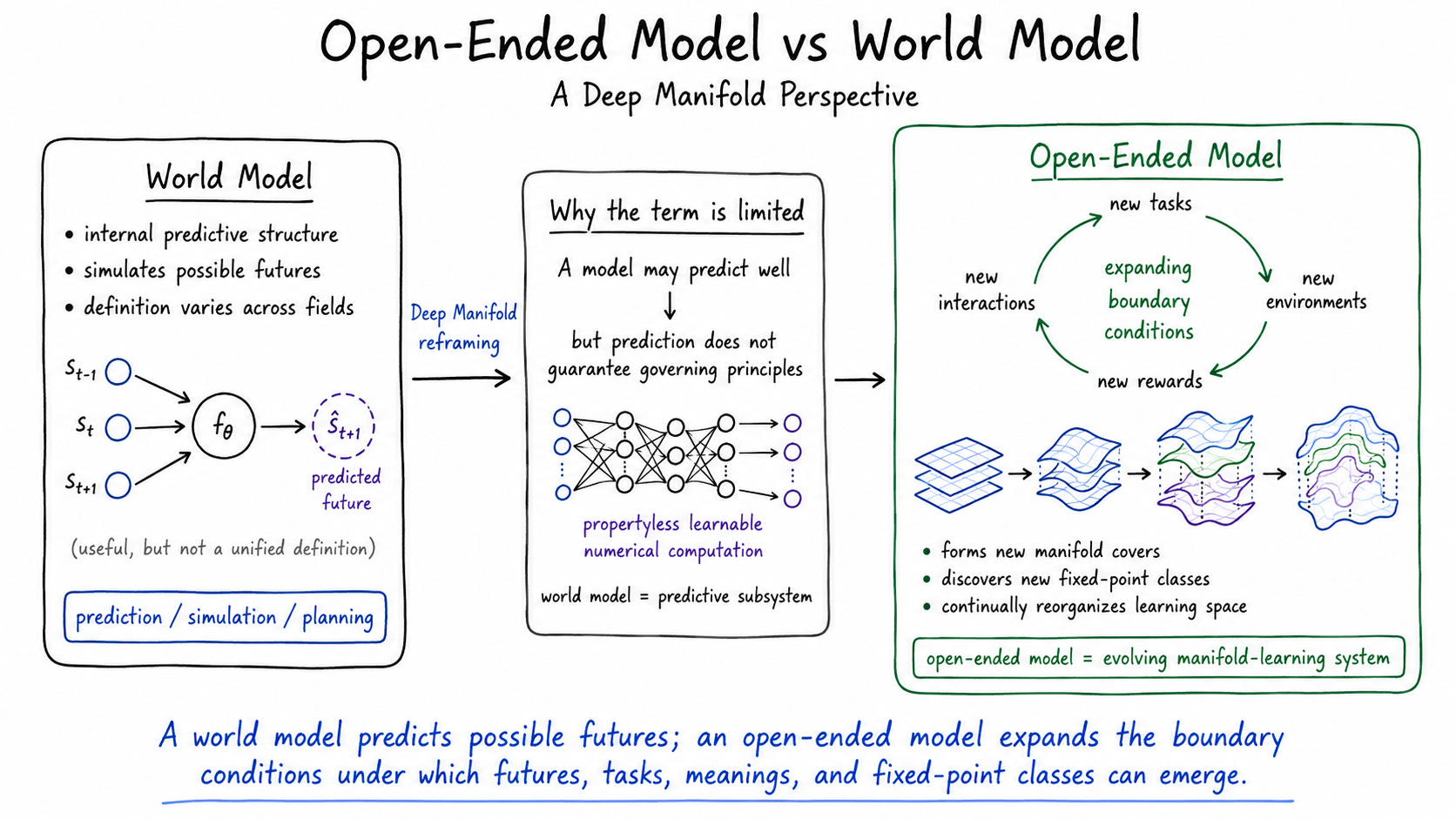
This reframing also avoids a common overclaim about neural world models. A neural model may predict well, but prediction alone does not guarantee that it has recovered the governing principles of the world. Neural networks are propertyless learnable numerical computation: they can absorb mixed, incomplete, weakly specified, heterogeneous structures, but they do not automatically possess physical grounding or mechanism. In this sense, a world model is a predictive subsystem, while an Open-Ended Foundation Model is a continuously evolving manifold-learning system whose boundary conditions keep expanding.
这种重新表述也避免了关于神经世界模型的一种常见过度声称。一个神经模型即使预测得很好,也并不保证它已经恢复了世界的支配原理。神经网络是无属性的可学习数值计算:它们能够吸收混合的、不完整的、弱规范的、异构的结构,但并不自动拥有物理接地性或机制。从这个意义上说,世界模型是一个预测性子系统,而开放式基础模型则是一个持续演化的流形学习系统,其边界条件不断扩展。
6. Evolution as Open-Ended Manifold Search 进化作为开放式流形搜索
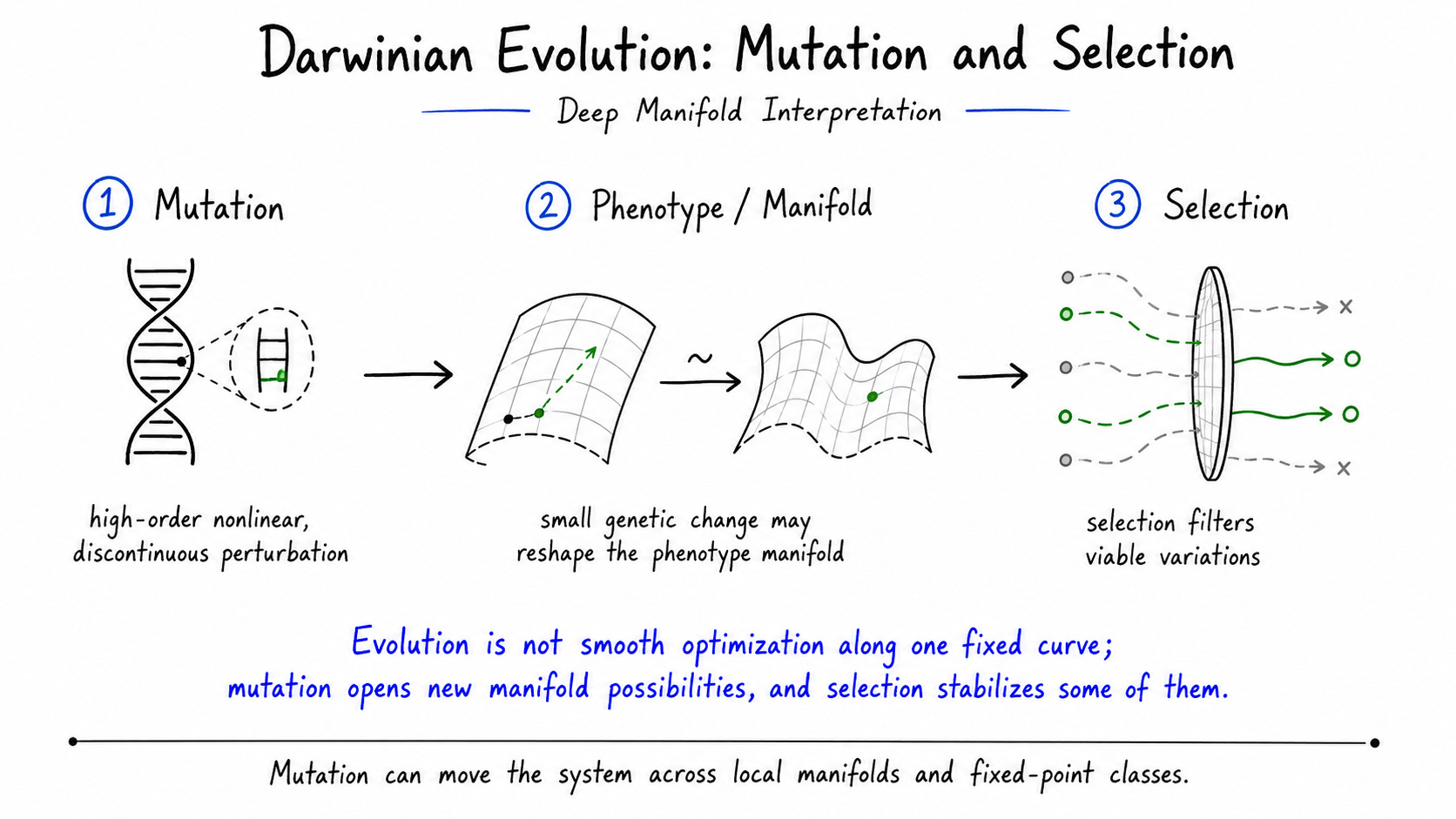
Darwinian evolution can be understood as the interaction between selection and mutation: selection filters existing variations, while mutation creates new possibilities. From the Deep Manifold perspective, mutation is not merely a small random change; it can act as a high-order nonlinear and discontinuous perturbation. A tiny genetic change may produce no visible effect, or it may propagate through gene expression, development, morphology, behavior, and environment to reshape the entire phenotype manifold. In this sense, evolution is not smooth optimization along a fixed curve, but a dynamic process in which mutation, recombination, environment, and selection push organisms across local manifolds and fixed-point classes, opening new spaces of form, adaptation, and open-ended complexity.
达尔文进化可以理解为选择与突变之间的相互作用:选择筛选已有的变异,而突变创造新的可能性。从深度流形的角度看,突变并不仅仅是一个微小的随机变化;它可以作为一种高阶非线性且不连续的扰动。一个很小的基因变化,可能没有任何可见影响,也可能通过基因表达、发育过程、形态结构、行为方式和环境相互作用层层传导,最终重塑整个表型流形。从这个意义上说,进化并不是沿着一条固定曲线进行的平滑优化,而是一个动态过程:突变、重组、环境和选择共同推动生命体跨越局部流形与不动点类,打开新的形态空间、适应空间和开放式复杂性。
7. Property-Less Computation, Counting, and Classification 无属性计算、计数与分类
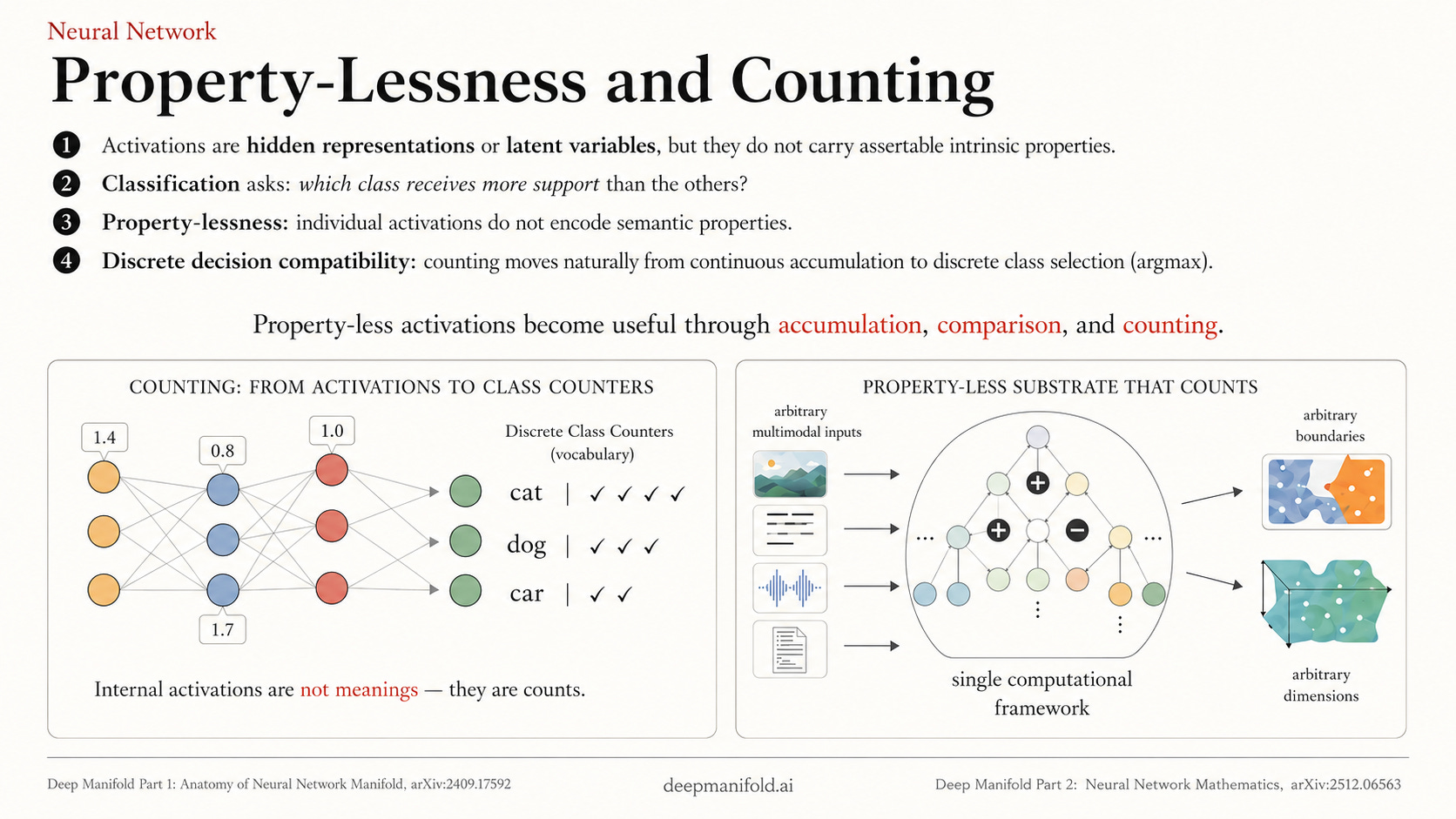
Through Deep Manifold, we discovered that a neural network forward pass is better understood as an iterated integral across layers: each layer accumulates, transforms, and passes forward numerical states under the boundary conditions given by data, architecture, and prompt. These internal activations are propertyless: they are not meanings, semantic objects, or intrinsic representations by themselves. Their usefulness comes from accumulation, comparison, and counting. In classification or next-token prediction, the network does not “understand” a class as a property inside one activation; rather, it accumulates numerical support across many layers and directions until the final logits act as class counters. In this sense, neural computation is propertyless numerical integration that becomes decision-making through counting.
通过深度流形,我们发现神经网络的前向传播更适合被理解为一种跨层的迭代积分:每一层都在数据、架构和提示词所给定的边界条件下,累积、变换并继续传递数值状态。这些内部激活本身是无属性的:它们并不是意义、语义对象,也不是具有内在性质的表征。它们的作用来自累积、比较和计数。在分类或下一个单标预测中,网络并不是在某一个激活中“理解”一个类别的属性;相反,它是在许多层、许多方向上累积数值支持,直到最终的 logits 充当类别计数器。从这个意义上说,神经计算是一种无属性的数值积分,并通过计数转化为决策。
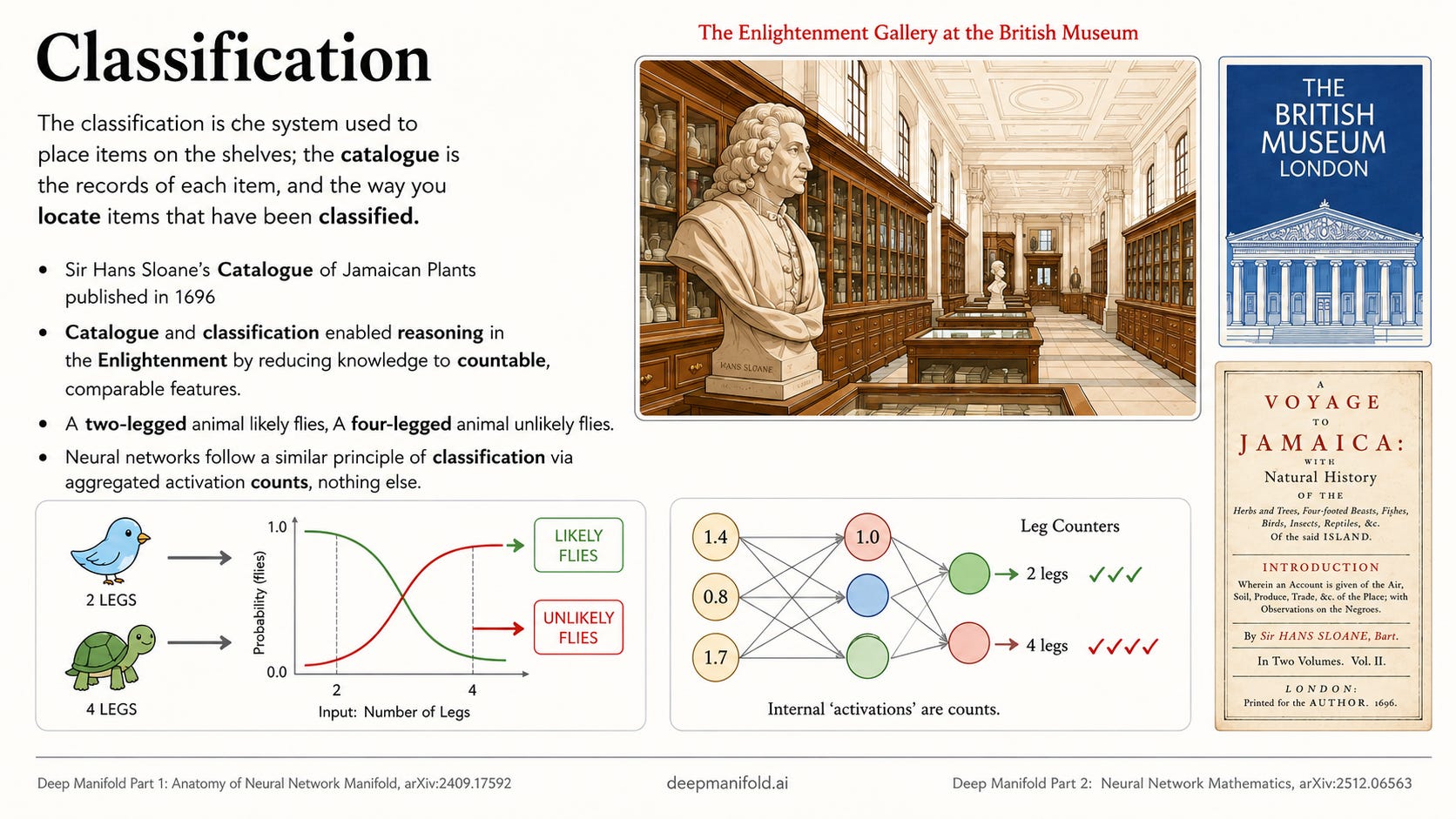
Neural networks may be closer to how humans understand the world than we usually admit. Human reasoning has always depended on cataloguization and counting: we classify plants, animals, objects, actions, and concepts by reducing the world into countable, comparable features. The Enlightenment catalogue was not merely a storage system; it was a reasoning machine. Once things were placed into classes, features could be compared, counted, and inferred. A two-legged animal likely flies; a four-legged animal likely does not. Neural networks follow a similar principle, but in numerical form: internal activations do not need to carry intrinsic semantic properties. They accumulate support, compare alternatives, and count toward classification.
神经网络其实可能比我们通常承认的,更接近人类理解世界的方式。人类推理一直依赖于编目化与计数:我们通过把植物、动物、物体、行为和概念分类,将世界还原为可以计数、可以比较的特征。启蒙时代的百科式编目并不仅仅是一个存储系统;它本身就是一台推理机器。一旦事物被放入类别之中,特征就可以被比较、计数和推断。两条腿的动物更可能会飞,四条腿的动物通常不会。神经网络遵循着类似的原则,只不过是以数值形式进行:内部激活并不需要携带内在的语义属性。它们只是累积支持、比较候选,并通过计数走向分类。
8. Category theory, Lattice Space, and Neural Reasoning, 范畴论、格空间与神经推理
Interestingly, this is where category theory and lattice space can provide a beautiful mathematical language for reasoning. A catalogue organizes entities into classes and relations; a lattice organizes possible classifications, refinements, joins, and meets. From the Deep Manifold view, neural computation is propertyless numerical accumulation, but its outputs become meaningful through classification structure. The model does not “possess” meaning inside one activation; meaning emerges when many propertyless counts are organized into a catalogue-like or lattice-like decision geometry. In this sense, neural networks imitate a deep historical pattern of human understanding: to reason is first to classify, compare, and count.
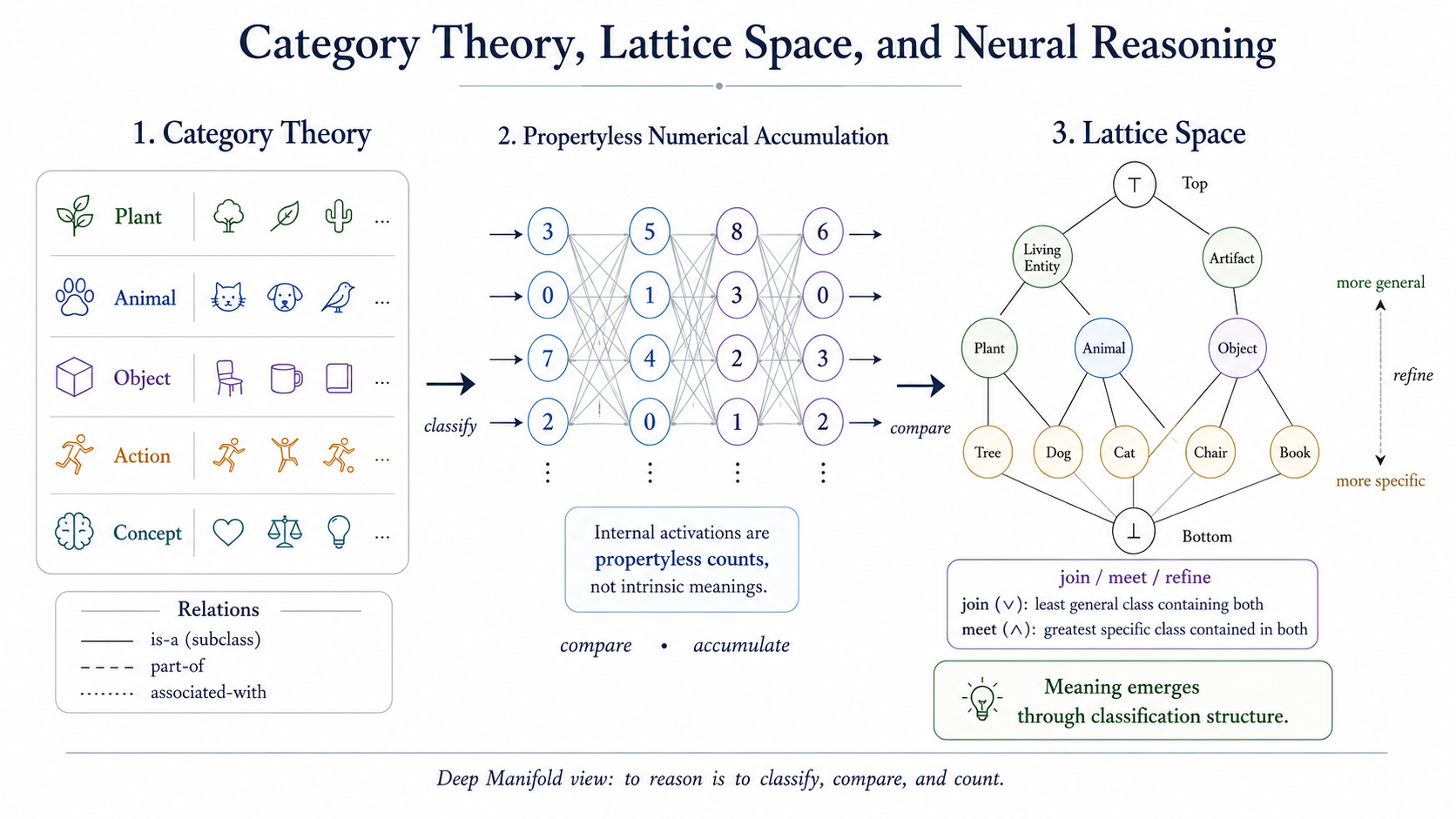
有意思的是,范畴论和格空间可以在这里为推理提供一种优美的数学语言。编目将实体组织成类别和关系;格空间则组织可能的分类、细化、并、交、上确界与下确界。从深度流形的角度看,神经计算是一种无属性的数值累积,但它的输出通过分类结构获得意义。模型并不是在某一个激活中“拥有”意义;意义是在许多无属性计数被组织成类似范畴或格结构的决策几何时涌现出来的。从这个意义上说,神经网络模仿了人类理解世界的一种深层历史模式:推理首先是分类、比较和计数。
9. Property-Lessness as Universal Open-Ended Learnability 无属性性作为通用开放式可学习性
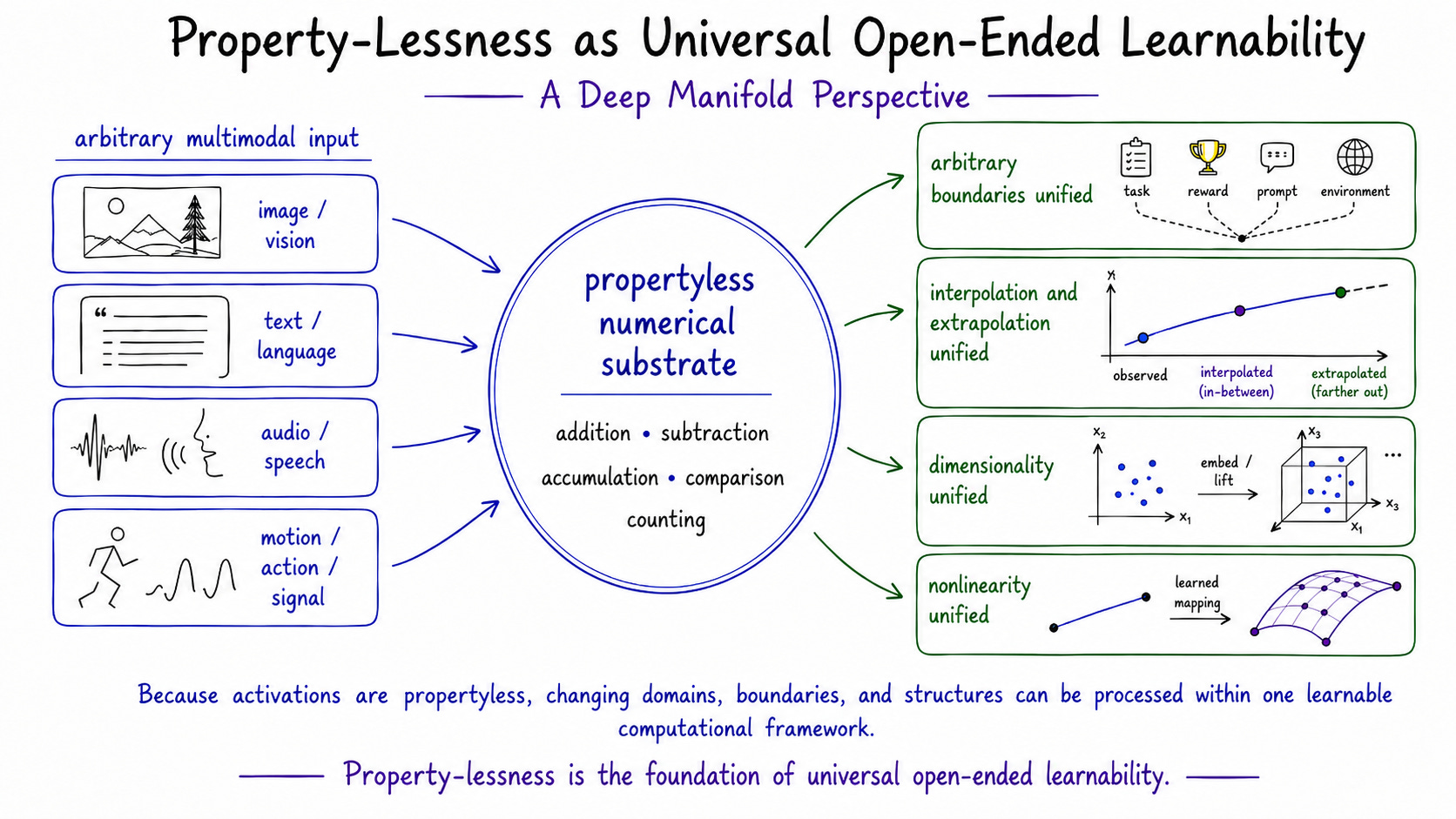
Property-lessness is the fundamental condition that makes open-ended learning possible. Neural-network computation reduces to primitive numerical operations: addition, subtraction, accumulation, comparison, and counting. These operations do not carry intrinsic physical, semantic, or symbolic properties. Precisely because internal activations are propertyless, they can absorb many kinds of structures into the same computational substrate. Images, text, audio, motion, geometry, actions, rewards, and contexts can all enter one learnable numerical framework.
This property-lessness is what allows open-ended learning to remain universal.
Arbitrary multimodal input is unified because different data types are converted into numerical states.
Arbitrary boundaries are unified because tasks, prompts, rewards, constraints, and environments all act as boundary conditions on the same learnable manifold system.
Interpolation and extrapolation are unified because both are movements through learned manifold covers, differing mainly in distance from known regions.
Dimensionality and nonlinearity are unified because the network does not begin with fixed physical dimensions or predetermined order of complexity; dimensional structure and nonlinear behavior emerge through learning. In this sense, property-lessness is not emptiness. It is the foundation of universal open-ended learnability: the reason a model can keep learning when the data, boundary conditions, tasks, and manifolds continue to change.
无属性性是开放式学习得以可能的根本条件。神经网络计算可以还原为最原始的数值操作:加法、减法、累积、比较和计数。这些操作本身并不携带内在的物理属性、语义属性或符号属性。正因为内部激活是无属性的,它们才能把许多不同类型的结构吸收到同一个计算基底之中。图像、文本、音频、运动、几何、行动、奖励和上下文,都可以进入同一个可学习的数值框架。
正是这种无属性性,使开放式学习能够保持其通用性。
任意多模态输入能够被统一,是因为不同数据类型都被转换为数值状态。
任意边界能够被统一,是因为任务、提示词、奖励、约束和环境都作为边界条件作用于同一个可学习的流形系统。
插值与外推能够被统一,是因为二者都是在已学习的流形覆盖中移动,主要差别只在于它们距离已知区域的远近。
维度与非线性能够被统一,是因为神经网络并不从固定的物理维度或预先规定的复杂性阶数出发;维度结构和非线性行为是在学习过程中涌现出来的。从这个意义上说,无属性性并不是空无,而是通用开放式可学习性的基础:它解释了为什么当数据、边界条件、任务和流形持续变化时,模型仍然能够继续学习。
10. Property-Lessness Fuels Discovery and Creativity, 无属性性推动发现与创造力
Property-lessness also helps explain why neural networks can generate discoveries and creative solutions that are difficult for humans to design directly. Because internal activations do not carry fixed semantic, physical, or symbolic properties, the model is not restricted to human-defined categories or step-by-step reasoning paths. It can move through many weak numerical associations, shortcuts, and latent pathways at once. Some of these pathways may look unintuitive or even invisible from a human perspective, but they can still connect distant regions of the learned manifold. This is why neural models sometimes appear to have a kind of “sixth sense”: not because they possess mystical understanding, but because propertyless computation allows them to search through intrinsic pathways that humans would rarely formulate explicitly.
无属性性也有助于解释,为什么神经网络能够产生人类很难直接设计出来的发现和创造性解法。因为内部激活并不携带固定的语义属性、物理属性或符号属性,模型并不受限于人类定义的类别或一步一步的推理路径。它可以同时穿行于许多微弱的数值关联、捷径和潜在路径之中。其中一些路径从人类角度看可能并不直观,甚至几乎不可见,但它们仍然能够连接已学习流形中相距很远的区域。这就是为什么神经模型有时看起来像是具有某种“第六感”:并不是因为它拥有神秘的理解能力,而是因为无属性计算使它能够搜索人类很少会显式构造出来的内在路径。
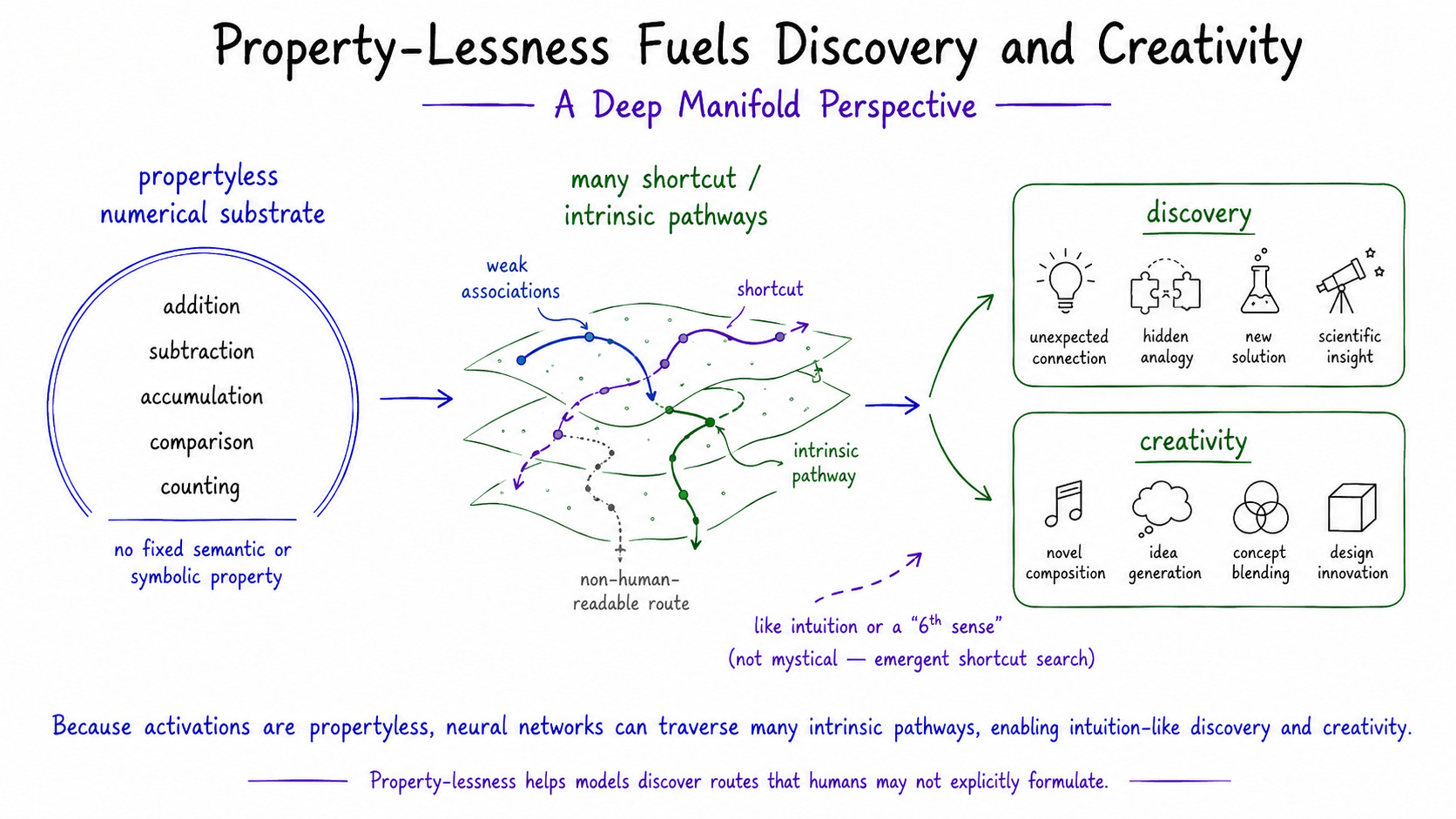
From the Deep Manifold perspective, creativity is not only recombination of known concepts; it is the discovery of new manifold routes under changing boundary conditions. Human reasoning often depends on explicit concepts, language, categories, and causal stories. Neural computation, by contrast, can accumulate and compare propertyless numerical traces across many layers and covers, forming shortcuts that bypass human-readable reasoning. These shortcuts can be fragile, but they can also be powerful: they may reveal hidden analogies, unexpected solutions, or new fixed-point classes before humans can name the mechanism. In this sense, property-lessness fuels open-ended creativity by allowing the model to explore intrinsic pathways beyond the limits of human conceptual structure.
从深度流形的角度看,创造力并不仅仅是已知概念的重新组合;它是在变化的边界条件下发现新的流形路径。人类推理通常依赖显式概念、语言、类别和因果叙事。相比之下,神经计算可以跨越许多层和许多覆盖,累积并比较无属性的数值痕迹,形成绕过人类可读推理的捷径。这些捷径可能是脆弱的,但也可能非常强大:它们可能在人类能够命名其机制之前,就揭示隐藏的类比、意外的解法或新的不动点类。从这个意义上说,无属性性通过允许模型探索超越人类概念结构限制的内在路径,推动了开放式创造力。