Mathematical Considerations for AI Scientific Discovery
From Learnability and Complexity to Open-Ended Scientific Intelligence

Chinese Edition: 关于人工智能科学发现的数学思考
Through the lens of Deep Manifold, we identified five mathematical foundations (Mathematical Considerations for Scientific and Engineering Intelligence) that give AI distinctive, and in some respects unique, advantages for scientific discovery. These advantages come partly from the fact that neural learning operates very differently from how mathematicians are traditionally trained to formulate and solve problems, a point I explored in Mathematicians Are Not Trained This Way:
Inverse Problem — How learning occurs
Piecewise Manifold — How complexity is processed
Propertyless Activations — How any data can be processed together
Full-Rank Structure — How relationships are discovered
Category Theory — What is learned
To understand AI’s capacity for discovery, we first have to understand the learnability of neural networks. Discovery is therefore not a separate capability layered on top of learning; it emerges from the same mathematical structures and learning dynamics that allow neural networks to form, connect, and generalize relational structures. I discuss this connection in Mathematical Considerations for Neural Network Learning and Discovery.
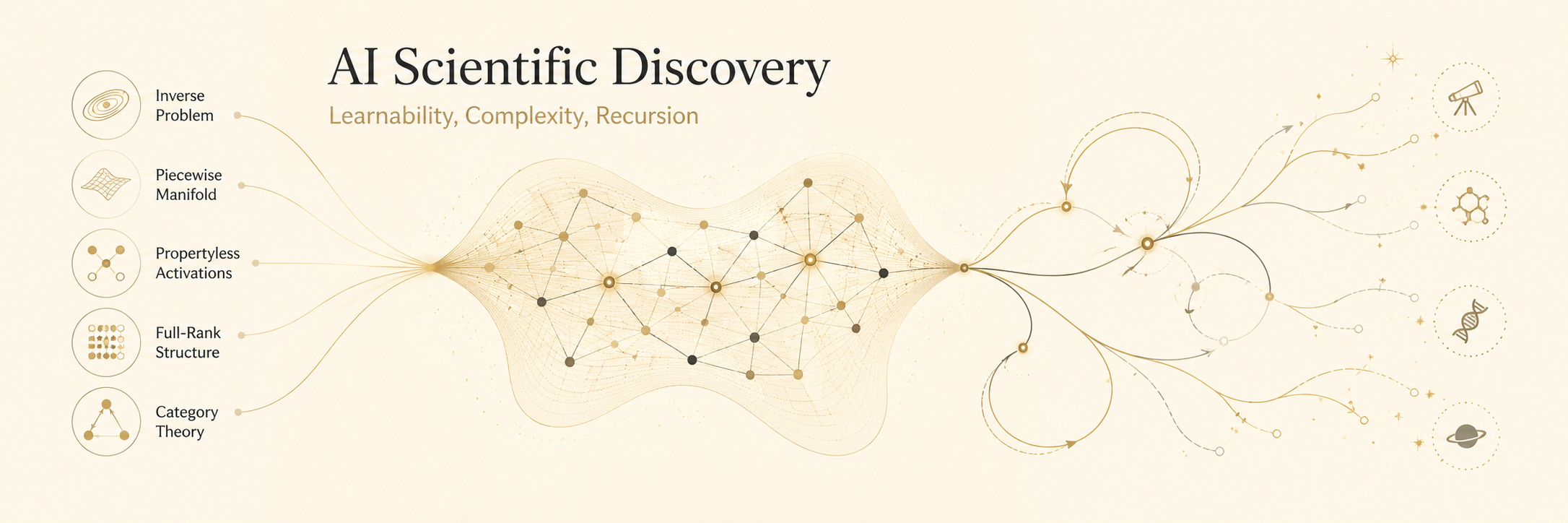
Scientific discovery is fundamentally a problem of complexity and emergence: neural networks can learn high-order relational structures, making them particularly suited to discovering patterns and relationships beyond conventional reductionist analysis. But this capability also depends on whether the model can actually learn the required structure, a question I examine in Mathematical Considerations for Learning Complexity.
These foundations explain why neural networks can learn complex relational structures and why they may be unusually capable of scientific discovery. The next question is what happens after such structures have been learned: how can they be revisited, extended, connected, and ultimately evolved? This brings us first to recursion, and then to why recursion alone is not enough.
Recursion as Mathematical Properties of Neural Network
Category theory begins with transformations and their composition rather than with the intrinsic properties of objects. In a Transformer, each layer acts on the token geometry produced by previous layers and generates a new state available for further transformation. The layers do not need to share parameters: recursion arises from compositional closure, because each output remains inside the same computational structure and becomes the condition for subsequent computation.
This recursion extends beyond activation values. Attention reconstructs token relationships, learned projections change their coordinates and orientations, and residual connections carry earlier mathematical covers into later layers. As illustrated below, Deep Manifold Part 1: Anatomy of Neural Network Manifold, Section 4.1, and Deep Manifold Part 2: Neural Network Mathematics, Section 5.3, suggest an interconnected toroidal geometry whose closed and interconnected pathways permit computational states to return to related regions, re-enter earlier relational structures, and continue along different local routes. Such geometry makes recursive revisitation and refinement geometrically possible.
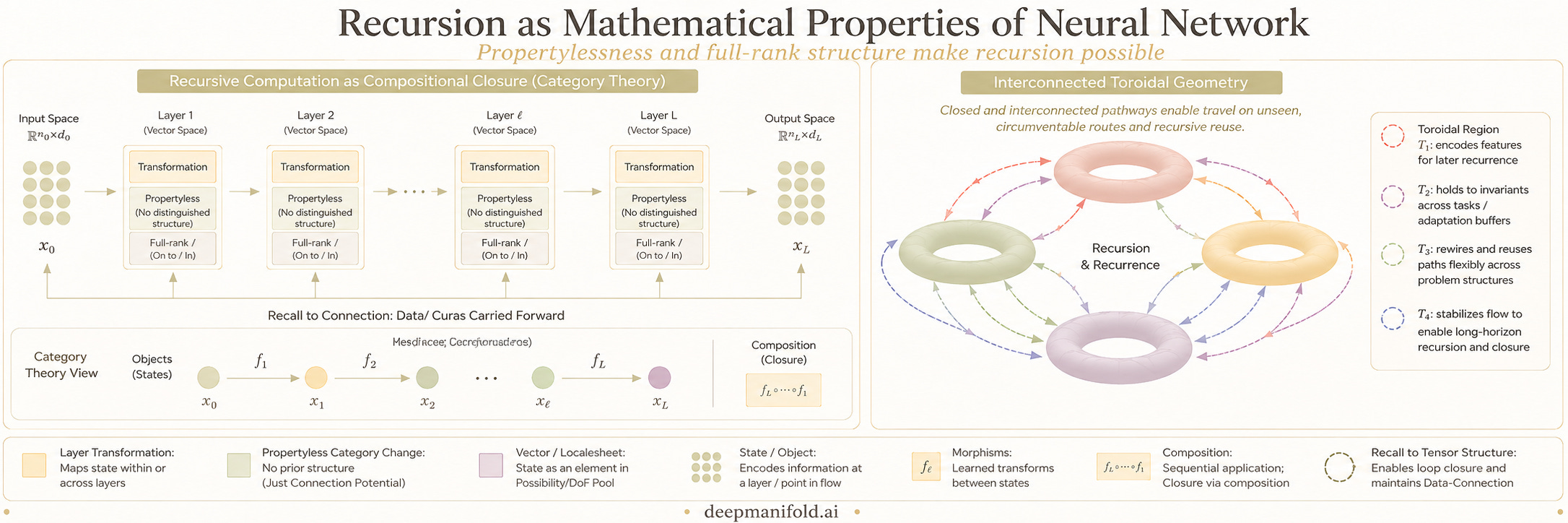
Category theory therefore explains why recursion is mathematically natural through repeated composition, while interconnected toroidal geometry provides a possible geometric structure for realizing it. From the Deep Manifold perspective, recursion is not merely a literal self-loop or the repetition of an identical operation. It is the capacity of neural computation to revisit, transform, and recombine relational structures across successive mathematical covers. Fixed-point iteration is its limiting form, in which continued transformation produces an increasingly compatible neural state.
Recursion Is Not Enough
Recursion allows a neural network to repeatedly transform, refine, and reuse its internal states, but repetition within the same architecture does not by itself create unlimited learnability or discoverability. Most current foundation models remain giant monolithic models: enormous amounts of knowledge, scale, modality, and nonlinear structure are forced into one globally coupled manifold. As discussed in Mathematical Considerations for Giant Monolithic Models, increasing size does not remove the difficulty of preserving local precision, plasticity, and global geometric coherence. A more promising future is Manifold Federation, in which specialized, elastic local models maintain their own learning spaces, pathways, boundary conditions, and fixed-point classes while participating in a dynamically coordinated global system. Such a federation can distribute learning complexity, preserve local granularity, and open more diverse discovery pathways than recursion inside one increasingly rigid model as described in Mathematical Considerations for Manifold Federation.
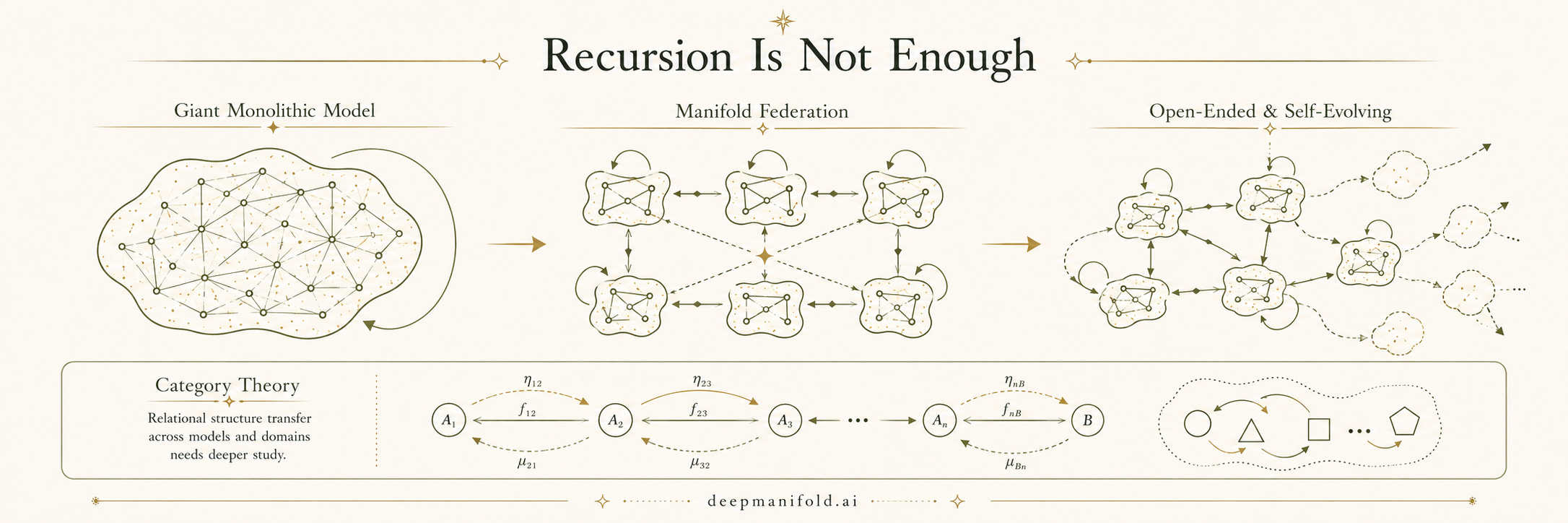
The ultimate goal is not merely a model that recursively processes what it has already learned, but one that remains open-ended and self-evolving as its data, tasks, environments, and boundary conditions continue to change. Mathematical Considerations for Open-Ended Foundation Models describes this as the continuing expansion of the learning space, while Mathematical Considerations for Self-Evolving Neural Networks extends it toward mutation, differentiation, selection, stabilization, and persistence of evolving manifold structures. Reaching that goal will also require a much deeper study of category theory in neural networks. As proposed in Mathematical Considerations for Transfer Learning through Category Theory and Mathematical Considerations for Expert Data Transfer, future learning systems must understand not only how to repeat transformations, but how relational and compositional structures can be mapped, preserved, compared, or rejected across models and domains. Recursion continues a pathway; category theory may help determine which structures can cross into an entirely new one.
Roadblocks to Discovery
The first roadblock is deceptive forward accuracy. As discussed in Mathematical Considerations for Scientific and Engineering Intelligence, an AI system may accurately reproduce observations or predict outcomes without discovering the true underlying mechanism. Compensating errors, non-identifiable parameters, and spurious correlations can all lead the model toward a fixed-point class that performs well while remaining physically or scientifically incorrect. Forward accuracy must therefore be tested against mathematical analysis, governing laws, numerical simulation, experiments, and independent domain evidence.
The second roadblock is the jagged and ill-posed nature of neural intelligence. Jagged behavior may keep discovery trapped inside a self-loop, repeatedly reinforcing one plausible hypothesis without opening a genuinely new pathway. It may also abruptly derail the discovery path when small changes in data, context, or boundary conditions produce large changes in the inferred structure. As argued in Mathematical Considerations for Jagged and Ill-Posed Intelligence, scaffolding, multi-step verification, external tools, and independent evaluation are not optional additions; they are stabilizers for an inverse process that does not naturally guarantee uniqueness or stability.
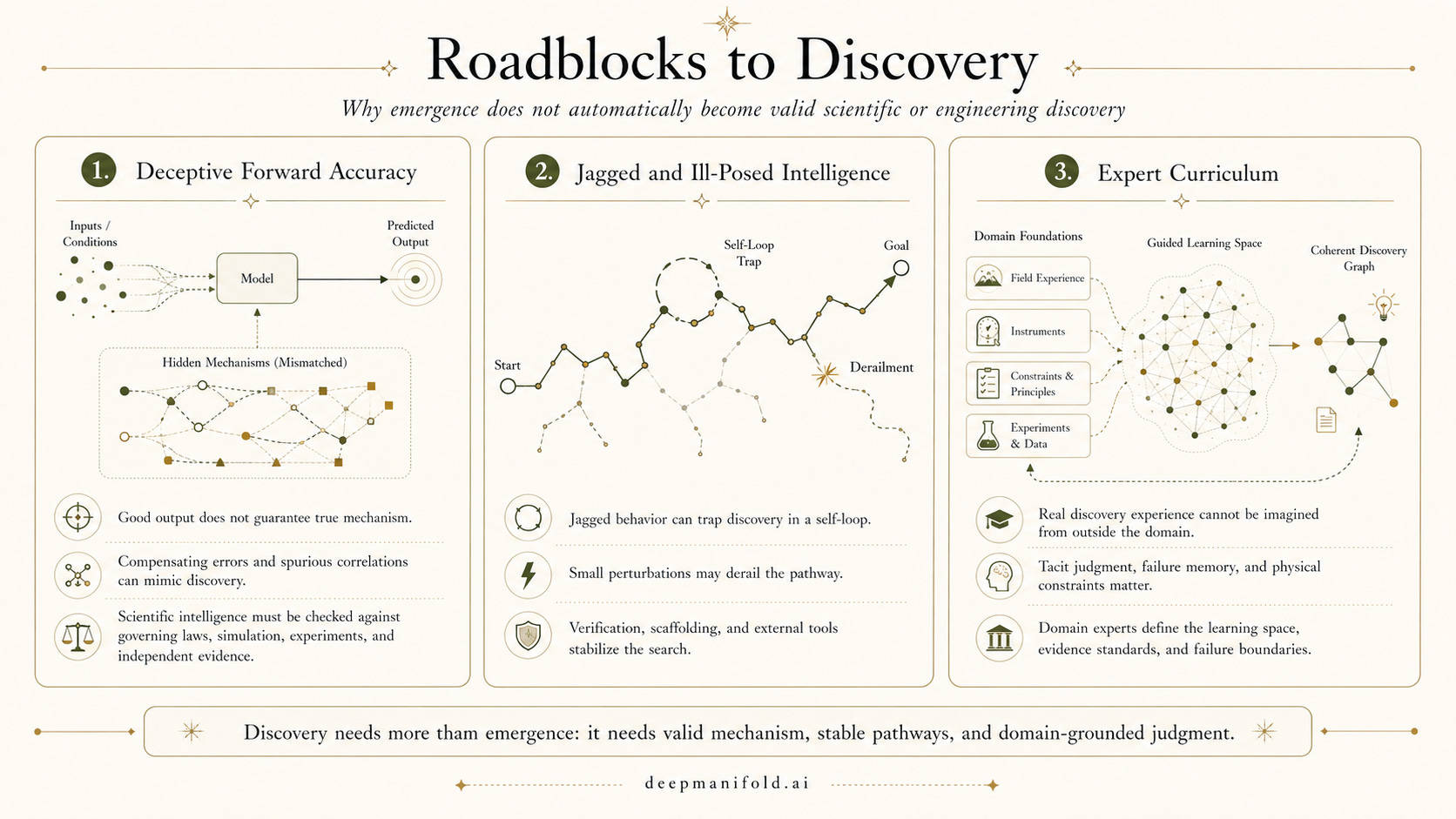
The third roadblock is especially important to me because I have seen the difference firsthand. Thirty years ago, I worked as a leading expert in numerical computation for discontinuous media on major engineering projects around the world. Real expertise did not come only from equations, papers, or simulation results; it came from confronting rock, sand, structures, field measurements, uncertainty, failed assumptions, and the consequences of being wrong. In An Expert, They Say and Expert Curriculum, I argue that giving AI more domain data is not enough, we also have to think about how it can acquire something closer to real domain experience.
A model can produce highly convincing forward results while relying on incomplete, unstable, or even false internal relationships. The deeper mathematical difficulty is explored in The Comedy of Neural Learning.
Mathematical Considerations for Scientific and Engineering Intelligence
Mathematical Considerations for Neural Network Learning and Discovery
This article is now listed under Scientific and Engineering Intelligence & Alignment and Mathematical Considerations Series in Deep Manifold, Two Years Later: 2024–2026.